FUN WITH FIREWORKS!?
FIREWORKS! FUN OR FRIGHTENING?
As the night’s draw in the chance of fireworks being let off increases. In Sussex Bonfire Season begins in September and continues through to December, and in other areas of the country fireworks may be use to celebrate Divali and at New Year.
Many pets are scared by fireworks, but they are here to stay…so what can you do?

PART ONE; DEALING WITH A DISPLAY
Dogs and cats and fireworks
Ideally you should start desensitising your pets to firework noises well in advance of bonfire season (see Part 2 Prevention) but it is easy to forget how upset your pet got until the nights start drawing in.
If bonfire season has crept up on you don’t try to start a desensitisation programme; instead plan to help your dog or cat cope.
Many dogs and cats like to retreat to a safe den during fireworks so make sure they have one. For dogs this might mean a crate covered in a blanket, or putting their bed behind the sofa. Cardboard boxes work well for cats! Introduce these safe dens in advance of bonfire season if possible. Some dogs and cats respond well to tight fitting calming vests called Thunder Shirts.
Consider pheromones which can help to relax pets. DAP (for dogs) comes as a collar, diffuser, or spray; and Feliway for cats comes as a diffuser or spray. Both are available from your vet or online, and should be used for a couple of weeks before you expect fireworks to start. Your vet might also suggest herbal and nutraceutical calmers. Some of these act very quickly, others should be given for a week or so before you expect fireworks. For more serious firework phobias your vet may prescribe sedative or anxiolytic drugs, but be sure to book an appointment to discuss these well ahead of time. A new, very effective gel is available which acts quickly to calm pets with noise phobias, even if they are already showing signs of fear, but this can only be prescribed after consultation with your vet. Some owners find a big carbohydrate meal in the evening helps their dogs be calmer during fireworks, but don’t do this if your dog tends to have vomiting or diarrhoea when stressed.
Keep your pet indoors when you know a bonfire event is planned. As people may let fireworks off outside planned event times it is sensible to lock cat flaps after dark and to ensure your dog has been walked before dusk. Close curtains and turn on the lights so flashes outside are less noticeable. If your dog is particularly afraid of fireworks it would be sensible to take him into the garden on a well-fitting collar or harness and lead to toilet during fireworks season, just in case one goes off. Also make sure the garden is secure to reduce the risk of escape.
During a display have the TV or radio on to mask sounds and as a distraction. Some dogs can be distracted during fireworks by play or training exercises, others will want to cuddle up for security, and others will feel best in their den. Be guided by your dog and don’t try to make him do anything he doesn’t want to. Don’t leave dogs which are likely to be distressed by fireworks on their own during displays. The easiest solution for some dogs living close to organised displays can be to go and visit a friend in another village for the evening.
Horses and fireworks
Most horses will be safest in their stables during firework displays, however make sure someone is watching them and can take action if they become afraid. Some horse will react badly if in an enclosed area as they can feel trapped, and will be better released into a paddock. If your horse is nervous prepare for a nearby event by rugging and booting them to reduce the risk of injury. Your vet may also be able to prescribe either herbal or nutraceutical calmers, or sedatives for badly affected horses. Alternatively consider moving very nervous horses to stables or field further away from the event.
Livestock and fireworks
Livestock will startle at the beginning of a display but usually settle fairly quickly when they realise there is no harm. Like horses they may react more badly to being in a confined space. Move sensitive livestock such as in calf cows and pregnant ewes as far from the event as possible and ensure that fences are secure and safe to reduce the risk of injuries.
Small pets and fireworks
Small pets such as rabbits and guinea pigs being kept outside could be scared by the noise and flashes of fireworks so consider bringing their hutch inside during bonfire season. If you notice a decrease in how much your rabbit or guinea pig is eating visit the vet as stress can cause gut stasis, which can be serious if left untreated.
NEEM
NEEM FOR PARASITE CONTROL

When our Holistic Vet Vicky goes on holiday she can’t help but look around for medicinal plants and she found lots of Neem trees in Kenya. The latin name for Neem is Azadirachta Indica.
WHAT IS NEEM USED FOR IN ANIMALS?
Neem is a popular remedy with indigenous peoples for a large range of parasitic problems on both animals and plants. Published research shows that extracts from neem seeds and leaves can be effective on animals against mites, ticks, fleas, and fungal infections. Neem can have various effects on parasites including repelling them, reducing their feeding on an animal, disturbing the growth of larval stages, and reducing the parasite’s ability to breed or lay viable eggs.
GREAT! WHY AREN’T WE ALL USING NEEM?
The main downside to neem is that it has a smell most people find unpleasant. Commercial neem based products will attempt to disguise this, or will use extracts with less smell. Neem extracts degrade fairly quickly after application so need to be applied every 4-8days.
IS NEEM SAFE?
Aqeuous preparations of neem are reported to be well tolerated, neem oils may be less well tolerated. Short term overdose, or long term use, may be associated with reduced fertility. Fertility returns once treatment is stopped. Ingestion of pure neem seed oil is dangerous and can cause vomiting, metabolic acidosis, drowsiness, a rapid rate of breathing, and even seizures. The best advice would be to use commercially available products which have been tested as safe for use on animals, and to use and store neem products in a way which minimises the risk of your pet ingesting them. Be sure to choose cat safe products for cats, who are especially at risk from ingesting essential oils.
Neem also appears to be relatively safe to non-target insects and spiders, but may be toxic to fish so take care around your fish tanks and ponds.
TURMERIC; SUPERFOOD OR SUPERFAD?
TURMERIC; A WONDERHERB FOR PETS! Or is it?

USES FOR TURMERIC IN PETS
The main reasons pet owners use turmeric are for arthritis and for cancer prevention.
Although there is plenty of anecdotal evidence that turmeric helps pets with arthritis, there have been relatively few clinical studies. In Vitro (lab studies in isolated tissues) studies have shown that turmeric extracts can reduce inflammatory cytokines, and reduce cartilage degradation. Turmeric appears to work like some of the more modern anti-inflammatory drugs by inhibiting COX2 enzymes which cause inflammation in preference to COX 1 enzymes which are needed for many normal processes in the body. Studies in live animals have in some cases shown little effect from giving turmeric, but in others have shown improvement in arthritis symptoms. Larger scale studies are needed to draw more accurate conclusions.
The role of turmeric in cancer cases is more complex. In lab tests turmeric extracts can actually cause DNA damage, which could increase the risk of cancer. However, the low risk of stomach cancer in people in India has been attributed to turmeric in the diet. Several studies have shown that turmeric extracts can inhibit cancer cell growth in the lab, but again, studies in live animals are lacking.
PROBLEMS WITH TURMERIC FOR PETS
Turmeric is a relatively safe herb to use, but one reason for this is that the active compounds aren’t very well absorbed. Dissolving turmeric in oil may increase its bioavailabity, as may adding in black pepper, however studies have focuses on rats and result may not be the same for dogs and cats.
Turmeric should be used with caution in pets who are receiving medications. Turmeric can inhibit an enzyme pathway which is important in breaking down some commonly used drugs including digoxin, anticoagulants, cyclosporin, and some anti-inflammatories. This could lead to toxicity over time. Turmeric has also been shown to reduce the absorption of iron from the diet.
In some animals turmeric is associated with irritation of the gut. If this cause vomiting or diarrhoea be aware that turmeric really stains! It should also not be used in animals with gallstones, or those with a tendency to produce oxalate crystals or stones.
Turmeric powder sold for cooking can have variable amounts of active compounds, and the volatile oils will be lost during drying and processing. Fresh roots contain more oils, but the growing conditions can still affect the levels of active compounds. Over the counter supplements don’t always contain sufficient quantity or quality of active compounds.
IS TURMERIC RIGHT FOR MY PET?
We like turmeric, and recommend it to many of our clients. But it won’t be suitable for all pets. We strongly recommend contacting a vet trained in herbal medicine to suggest if turmeric will be useful and safe.
New Year’s Resolution!
HAPPY NEW YEAR!
We want to say sorry for not keeping on top of the blog as well as we should have done this year. We’ve been very busy with Vicky our vet breeding a litter of puppies as well as completing coursework for her behaviour qualification.
HOLISTIC VETERINARY CLINICS:
Goudhurst Vets, Bedgebury Road on Thursdays from 11.30. Call direct on 01580 211981.
Companion Care Vets Eastbourne, Lottbridge Drove on Mondays and Fridays. Call direct on 01323 649315.
Home visits are available on Tuesdays, Wednesdays, and Thursdays within a 15mile radius of Ninfield (Battle, Bexhill, Hastings, St Leonards, Westfield, Fairlight for example). Call or text on 07958142959, or email health@holistcvetsussex.co.uk
HOLISTIC VETERINARY SERVICES AVAILABLE:
Herbal Medicine; we use practitioner only tinctures and herbal tablets, as well as supplements from Nutravet. In most cases we produce bespoke combinations of herbs specifically designed for your pet. Herbal medicines can be used alongside conventional medicines to increase their effects, or to reduce side effects, or they can be used on their own where conventional medicines are unavailable or unsuitable.
Acupuncture: we use acupuncture extensively for musculoskeletal problems, from muscle sprains in working dogs, to arthritis in older animals. We have also had success in some spinal injury cases, and in pets with incontinence.
Physiotherapy; we frequently recommend that owners carry out exercises at home to help their pet’s mobility, sometimes we will also recommend treatment by canine therapists such as bowen therapists and hydrotherapists.
Behaviour; Vicky is a trained animal behaviourist and is happy to discuss prevention of problems in young animals, as well as helping owners understand and treat their pet’s behaviour problems. An understanding of the behavioural needs of pets also means we can help them cope with changes to their lifestyle caused by illness or injury.
Nutrition; we feel a good diet is the key to a healthy pet! We fully support those owners who want to raw feed, but can also help adapt other diets to improve health and behaviour.
Pupternity Leave
PUPTERNITY LEAVE
Just a short post today to let you know we will have very limited availability for appointments for the next 2 weeks as vet Vicky’s dog is expecting a litter!
DOMINANT DOGS
HOW DO I DEAL WITH MY DOMINANT DOG?
NEWSFLASH….your dog isn’t dominant!
Dominance theory is out of date thinking. It was based on observations of captive wolf packs whose behaviour bears no resemblance to the dog in your home, and little to wild wolves!
DOOR RUSHING, LEAD PULLING, CLIMBING ON THE SOFA….ALL DOMINANT BEHAVIOURS!
NOPE!
Door rushing: Your dog wants to be the first to get out to the good stuff!
Lead pulling: Your dog wants you to hurry to the park to let him off for a run!
Sofas and beds: Your dog likes to be up high so he can see better, and the sofa smells of you!
SO! WHAT DO I DO WITH MY DOMINANT DOG?!
1) Accept your dog isn’t trying to take over your home, or the world. Dogs are pretty happy being dogs and letting us earn the money for food and balls and stuff. They might want to compete with you, or other dogs, for things like food, balls, the sofa, getting to the park first….but they don’t want to be boss.
2) Learn how dogs really see the world. They like food, other dogs, people, sniffing, fetching, digging, chewing, ripping stuff up (in varying amounts depending on the dog!). They do what makes them happy, they avoid what makes them unhappy.
3) Understand why your dog is doing things you don’t like. Have you taught him self control, to walk on a loose lead, to wait when you open the door? If you don’t teach your dog the rules of living in your house then….he’ll just be a dog!
4) If your dog starts doing things which are against your house rules, ask why. Are you, or another family member bending the rules? This can be very confusing for dogs! Is you dog hitting puberty/ getting old/ been ill/ had a bad experience?
QUIT WANTING TO BE A PACK LEADER…BECOME A TEAM LEADER!
If you want to play wolves….put on a fur suit and pee up the trees in your garden. Your dog still won’t know you’re an alpha wolf!
Instead of seeing dog ownership as a constant battle for supremacy, work on becoming a better team. Make sure you have clear rules about acceptable and unacceptable behaviour. Teach your dog the rules through fair methods of training where he can earn rewards (food, play, cuddles) for making the right choices.
If you are having bigger training or behaviour issues get in touch!
Extra Reading:
We don’t often suggest extra reading but there are a few great books if this has piqued your interest…
‘The Culture Clash’ Jean Donaldson
‘Dominance in Dogs; Fact or Fiction” Barry Eaton
‘How Dogs Learn’ Birch and Bailey
Brain Food
CHANGE THE DIET, CHANGE THE BEHAVIOUR?
If you spend any time on the internet, reading dog magazines, or in pet shops, you will be aware of the huge range of foods out there promising your dog a longer, happier life. But could a change of diet really help change your dog’s behaviour?
CAN DIET FIX BEHAVIOUR PROBLEMS?
Some behaviour problems may actually be related to a dog’s diet. Take the case of a collie who was attacking his owners when they tried to sit on the sofa. Initially it was thought that the dog was guarding the sofa, but when the behaviourist visited in the daytime there was no attack… careful questioning revealed that his behaviour was more related to the time of day, than the sofa. His owners were very active people and only tried to sit on the sofa in the evening. They were only feeding their dog in the mornings and then he was having long, exciting walks. By the evening the collie was tired and had low blood sugar which made him extremely grumpy. He would curl up to sleep on the sofa and when woken by his owners he was so confused he would snap at them. This dog didn’t need retraining….just food at tea time as well as at breakfast!
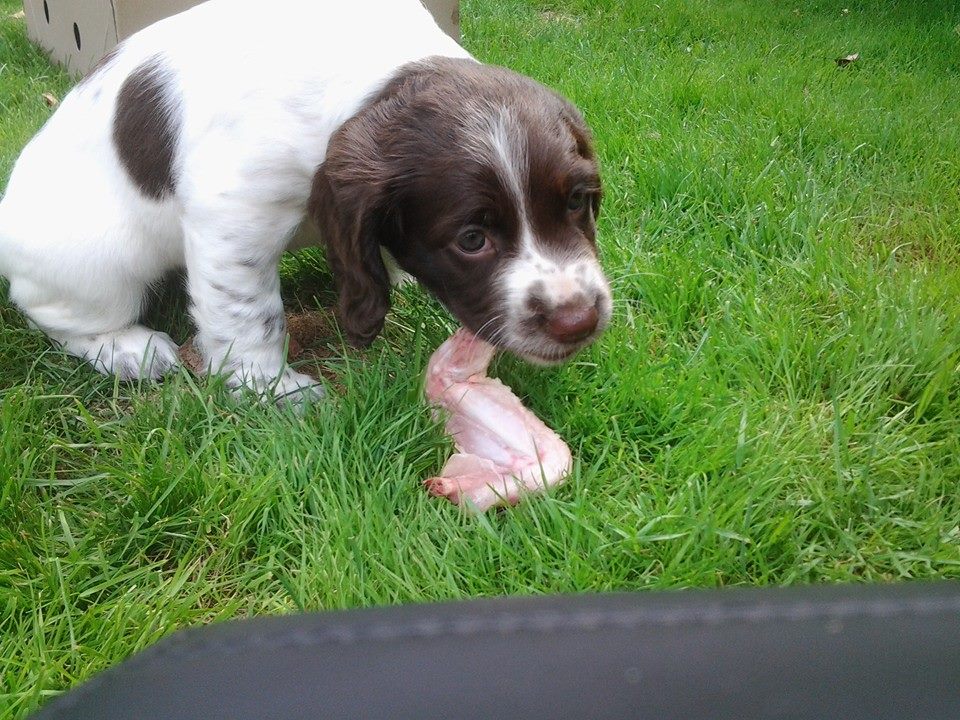
Another case involved a rescue springer spaniel who suffered badly with shadow chasing which meant he could only be exercised at certain times of day. Being a springer this meant he had lots of pent up energy and could be destructive in the house. To help, a trainer recommended a very low protein diet…which made the poor dog worse. Reducing the protein in his diet meant that he wasn’t getting the raw materials to make the brain chemicals that make dogs (and people!) happy. Against his owners expectation switching him onto a diet of raw meat, vegetables, and bones didn’t send him crazy, it improved his behaviour a lot. And chewing on large, meaty bones not only provided essential amino acids, it gave him a very satisfying activity to do when it was too sunny to take him out for walks.
One of the advantages of a behaviour consultation with our holistic vet is that she will consider your dog’s diet, health, and exercise when assessing problem behaviours. Key areas she will consider are the quality and quantity or protein, and how often the dogs is fed. Not all protein sources are the same; muscle meat is important in a dog’s diet to supply essential amino acids. These can’t be manufactured in the body and are vital building blocks for proteins, hormones, and messenger chemicals in the body and brain. Some diets seem to have sufficient protein, but it comes from vegetable sources, or from feet and feathers which don’t have the right levels of essential amino acids. Some dogs cope well when fed once a day, but the very active dog, young dogs, and toy breeds can suffer from low blood sugar on once a day feeding. Low blood sugar can cause confusion, grumpiness, and in severe cases collapse or fits.
A DIET TO RAISE SEROTONIN
For some dogs low serotonin is the cause of their problem behaviours, or makes it difficult for them to learn new behaviours. Serotonin levels in the brain can be raised through the use of drugs usually used for depression in people. Unfortunately these drugs can have side effects and getting the right drug for the dog (or human!) can be a case of trial and error. In many dogs, switching from a diet with low protein quantity or quality (like the springer we discussed above) to a diet with higher muscle meat levels, or a raw meat based diet can lead to improved behaviour. In others behaviour does not improve enough. Various supplements are sold containing tryptophan, the essential amino acid which is needed to produce serotonin. These have a limited effect on brain serotonin levels however, as tryptophan is often broken down before enough of it can enter the brain as it competes with other amino acids to cross the blood-brain barrier.
The good news is that our clever colleagues have designed a diet that allows plenty of tryptophan to enter the brain, which in turn means higher serotonin levels, and a happier dog!
We have been recommending this serotonin raising diet to our clients for several years and we have used it with owners who are raw feeding, as well as those who prefer prepared wet or dry foods, Sadly the DIY version we recommend has proved difficult for some owners as it involves feeding four times a day. For owners who raw feed, or who have very fussy dogs we will still recommend the DIY serotonin raising diet (please book as consultation for details!). However, for those owners who would prefer to feed a kibble food twice a day we will recommend Breakthrough ™.
If you think your dog might benefit from either the DIY serotonin boosting diet, or from Breakthrough™, we would strongly advise you to book a behavioural assessment. If you decide to try Breakthrough™ before a consultation, please thank us for making you aware of it by choosing 02301 Four Seasons Holistic Veterinary Care as your referring behaviour practice.
KIBBLE? BUT AREN’T YOU PRO RAW FEEDING!!!!?
We don’t judge our clients. We aim to help as many pet owners as possible improve the physical and mental health of their pets through a truly holistic combination of conventional diagnostics, conventional medicines, acupuncture, physical therapy, behavioural assessment and treatment, herbal medicines, nutritional supplements, and dietary changes, as appropriate for each client and pet.
We do love raw feeding as it allows owners to feed high quality protein, and to know exactly what their pet is eating. Some dogs don’t do well on grain based diets, and others become intolerant of processed meat proteins so raw feeding can be ideal for these pets. It can be a cost effective way to feed, and when whole meaty bones are fed there is ample opportunity for chewing and food play. However, raw feeding isn’t for everyone! It may not be safe for those who are immunocompromised, and may not be practical for those without room to store meat and bones. It is also unsuitable for dogs with food guarding issues until these have been addressed. If our clients want to feed raw we will help them every step of the way, even adapting the serotonin raising diet to suit raw feeding. However, for those who can’t or won’t raw feed, we will work with our client to find the best alternative.
Hugging Dogs
DON’T HUG YOUR DOG!
Really? Well, that’s the headline…but you know us, we like to get behind the headlines.
DOGS DON’T LIKE HUGS!
Researchers studied 250 photographs of dogs being hugged and concluded that 80% of them showed signs of being unhappy which has lead to hysterical headlines in the papers, online, on TV and radio, yet every post we’ve seen has pet owners fighting back, “but my dog loves cuddles”!
Most dogs do enjoy physical contact with humans. Many come to us for stroking and tummy rubs, push their heads under our hands, and try to climb up on our laps for cuddles. Stroking or grooming a dog can have positive effects on both parties, with both getting a hit of oxytocin – a hormone normally associated with bonding between mums and babies, or between lovers. The problem comes when a dog is restrained for cuddles against his wishes. A dog who has come to his owner for affection will be feeling quite different from one who has been unwillingly grabbed for a dog hug selfie! In this circumstance the dog may feel afraid and trapped and may show signs of distress. The same can happen if a dog is approached by strangers or children who try to stroke or cuddle. Dogs are not so different to humans…think how good a hug from a friend makes you feel, then think about how uncomfortable a hug from a total stranger in the street might feel!
How can you tell if your dog is comfortable with a hug? Your dogs has many subtle ways of telling you how he feels but they can be quite subtle. If he’s struggling and trying to get away that’s a pretty clear sign he doesn’t want a cuddle! If he is licking his lips, you can see the whites of his eyes, his mouth is closed with tight lips, and he seems to be looking away from you, he also doesn’t want a cuddle. Ignore these signs as your dog might feel he has to warn you with a growl, and if he’s still ignored he might snap at you. He won’t mean to bite first time, but humans are so slow…. Be especially careful to watch for these warning signs when children or friends are petting your dog, and never be afraid to step in and protect him from unwanted physical attention.
We don’t often post links tat take you away from our page, but this one has a nice slideshow about dog body language: http://www.doggonesafe.com/speak_dog
DOGS LIKE HUGS FROM PEOPLE THEY KNOW AND TRUST
The ‘take home’ message is don’t stop touching your dog! But do learn to ‘listen’ to his body language and respect him when he doesn’t want a cuddle.
ST JOHN’S WORT WORRIES
ST JOHN’S WORT RECALL

This week six batches of St John’s Wort products have been recalled because they have been found to contain high levels of a toxic pyrrolizidine alkaloid (PA). As PAs are not found in St John’s Wort it is thought that the products have been contaminated with weeds collected during harvest. Certain PAs can lead to liver damage if taken over a period of time and anyone using the affected products should stop using them for themselves or their pets straight away.
Whilst it is good news that these products have been tested, and a problem detected, it is concerning that the manufacturers do not appear to be taking the quality of their raw ingredients seriously enough. We have previously discussed herbal remedies which don’t contain any of the active chemicals, but accidental contamination and deliberate substitution of herbs are also risks.
The herbs that we supply come from companies which only supply trained herbal practitioners. They produce herbs to the same standard as pharmaceutical drugs, and check the chemical profiles of their products to ensure quality and safety.
For safe, effective herbal medicines for your pet always consult a trained Veterinary Herbalist!
For information on the recalled products:
https://www.gov.uk/government/news/precautionary-recall-six-batches-of-st-johns-wort-tablets
To find a Veterinary herbalist near you:
http://www.herbalvets.org.uk/